Early music
in astonishing
locations
Early music
in astonishing
locations
Early music
in astonishing
locations
Early Music Festival
festival Rane Glazbe
Early Music Festival
festival Rane Glazbe
Early Music Festival
festival Rane Glazbe
September & October 2026
September & October 2026
August to
October 2025
Scroll to Explore
FREE Entrance to all concerts
FREE Entrance to all concerts
FREE Entrance to all concerts
Years of tradition
24
Years of concerts
Years of tradition
24
Years of concerts
Festival Programme
4
Concerts in 2026
Festival Programme
4
Concerts in 2026
Performing in 2024 edition
34
Musicians
Performing in 2024 edition
34
Musicians
Attendees
957
Happy listeners
Attendees
957
Happy listeners
About
About
Dvigrad Festival is an exceptional cultural project dedicated to the historically based interpretation of the music of the Middle Ages, Renaissance and Baroque. The festival inherits a tradition of more than twenty years of continuous promotion of early music in the historical venues of continental and coastal Istria.
Dvigrad Festival is an exceptional cultural project dedicated to the historically based interpretation of the music of the Middle Ages, Renaissance and Baroque. The festival inherits a tradition of more than twenty years of continuous promotion of early music in the historical venues of continental and coastal Istria.
About
Dvigrad Festival is an exceptional cultural project dedicated to the historically based interpretation of the music of the Middle Ages, Renaissance and Baroque. The festival inherits a tradition of more than twenty years of continuous promotion of early music in the historical venues of continental and coastal Istria.
Concerts
Concerts
Concerts
September 5 2026, 8 p.m. OPENING CEREMONY
Basilica of St. Sophia, Dvigrad
Capella Itineris
I Piffari - Through the Seven Ages of Man
September 5 2026, 8 p.m. OPENING CEREMONY
Basilica of St. Sophia, Dvigrad
Capella Itineris
I Piffari - Through the Seven Ages of Man
September 12, 2026, 8 p.m.
Church of Saint Euphemia, Rovinj
Gli Angeli Genève
Johann Hermann Schein: Israelis Brünnlein / Fontana d'Israel (1623)
September 12, 2026, 8 p.m.
Church of Saint Euphemia, Rovinj
Gli Angeli Genève
Johann Hermann Schein: Israelis Brünnlein / Fontana d'Israel (1623)
September 29, 2026, 8 p.m.
Church of Saint Francis, Rovinj
Profeti della Quinta
Beauty in four parts: The Madrigals of Philippe Verdelot
September 29, 2026, 8 p.m.
Church of Saint Francis, Rovinj
Profeti della Quinta
Beauty in four parts: The Madrigals of Philippe Verdelot
October 1, 2026, 8 p.m.
Basilica of Saint Martin, Sveti Lovreč
Ensemble Responsorium
“Splendida Stella: Musical Reflections of Holiness in Seventeenth-Century Venice”
October 1, 2026, 8 p.m.
Basilica of Saint Martin, Sveti Lovreč
Ensemble Responsorium
“Splendida Stella: Musical Reflections of Holiness in Seventeenth-Century Venice”
Supporting the festival
Supporting the festival









The festival is organized under the esteemed patronage of the President of the Republic of Croatia.
The festival is organized under the esteemed patronage of the President of the Republic of Croatia.
Newsletter
Newsletter
Would you like to receive updates about upcoming concerts?
Subscribe to our newsletter to stay informed.
Would you like to receive updates about upcoming concerts?
Subscribe to our newsletter to stay informed.

Capella Itineris
Capella Itineris
OPENING CEREMONY Basilica of St. Sophia, Dvigrad
Basilica of St. Sophia, Dvigrad
September 5, 2026, 8 p.m
September 5, 2026, 8 p.m
OPENING CEREMONY
Marc Pauchard, cornetto and recorder
Teresa Orthner, cornetto and recorder
Morgan Jaffré, trombone
Constantin Meyer, trombone
Davide Lombritto, trombon
Marc Pauchard, cornetto and recorder
Teresa Orthner, cornetto and recorder
Morgan Jaffré, trombone
Constantin Meyer, trombone
Davide Lombritto, trombon

I Piffari - Through the Seven Ages of Man
I Piffari - Kroz Sedam ljudskih doba
I Piffari - Through the Seven Ages of Man
I Piffari - Kroz Sedam ljudskih doba
The program explores the repertoire of professional Renaissance and early Baroque wind ensembles (Stadtpfeiffer in Germany and Piffari in Venice) between 1600 and 1660. Because instrumentation was often left unspecified in contemporary sources, musicians frequently adapted works to suit the instruments available. The program highlights how cornetts, sackbuts, and dulcians were combined into versatile consorts capable of performing sonatas originally composed for such ensembles, arrangements of works intended for other instruments, and vocal polyphonic pieces performed da concerto with elaborate ornamentation (known as diminutions). In doing so, it illustrates a range of historical performance practices and reflects the practical, flexible, and creative approach to music-making that characterized the Renaissance and early Baroque periods.
The program explores the repertoire of professional Renaissance and early Baroque wind ensembles (Stadtpfeiffer in Germany and Piffari in Venice) between 1600 and 1660. Because instrumentation was often left unspecified in contemporary sources, musicians frequently adapted works to suit the instruments available. The program highlights how cornetts, sackbuts, and dulcians were combined into versatile consorts capable of performing sonatas originally composed for such ensembles, arrangements of works intended for other instruments, and vocal polyphonic pieces performed da concerto with elaborate ornamentation (known as diminutions). In doing so, it illustrates a range of historical performance practices and reflects the practical, flexible, and creative approach to music-making that characterized the Renaissance and early Baroque periods.
Gli Angeli Genève
Gli Angeli Genève
Gli Angeli Genève
Church of Saint Euphemia, Rovinj / Rovigno
Church of Saint Euphemia, Rovinj / Rovigno
September 12, 2026, 8 p.m.
September 12, 2026, 8 p.m.
Aleksandra Lewandowska, soprano
Dorothee Mields, soprano
Robert Getchell, tenor
Thomas Hobbs, tenor
Stephan MacLeod, bass & artistic director
Hager Hanana, violoncello
Giovanna Pessi, arpa tripla
François Guerrier, organ
Aleksandra Lewandowska, soprano
Dorothee Mields, soprano
Robert Getchell, tenor
Thomas Hobbs, tenor
Stephan MacLeod, bass & artistic director
Hager Hanana, violoncello
Giovanna Pessi, arpa tripla
François Guerrier, organ

Johann Hermann Schein: Israelis Brünnlein / Fontana d'Israel (1623)
Johann Hermann Schein: Israelis Brünnlein / Fontana d'Israel (1623)
A masterpiece of early seventeenth-century sacred music, Israelis Brünnlein/ Fontana d'Israel (Leipzig, 1623) is Johann Hermann Schein's most celebrated collection. Comprising twenty-six spiritual madrigals for five or six voices, it stands as one of the finest examples of the fusion of the traditional German motet with the expressive innovations of the contemporary Italian madrigal. Drawing on texts from the Old Testament, these expressive works combine the rich polyphonic tradition of the Renaissance with the emerging Italian Baroque style, creating music of remarkable emotional depth and rhetorical power. This program presents a selection from Schein's Israelis Brünnlein, revealing the composer's extraordinary sensitivity to text, vivid musical imagery, and masterful contrapuntal writing, offering a glimpse into one of the most significant collections of German sacred music of the early Baroque.
A masterpiece of early seventeenth-century sacred music, Israelis Brünnlein/ Fontana d'Israel (Leipzig, 1623) is Johann Hermann Schein's most celebrated collection. Comprising twenty-six spiritual madrigals for five or six voices, it stands as one of the finest examples of the fusion of the traditional German motet with the expressive innovations of the contemporary Italian madrigal. Drawing on texts from the Old Testament, these expressive works combine the rich polyphonic tradition of the Renaissance with the emerging Italian Baroque style, creating music of remarkable emotional depth and rhetorical power. This program presents a selection from Schein's Israelis Brünnlein, revealing the composer's extraordinary sensitivity to text, vivid musical imagery, and masterful contrapuntal writing, offering a glimpse into one of the most significant collections of German sacred music of the early Baroque.
Profeti della Quinta
Profeti della Quinta
Profeti della Quinta
Church of Saint Francis, Rovinj / Rovigno
Church of Saint Francis, Rovinj / Rovigno
September 19, 2026, 8 p.m.
September 19, 2026, 8 p.m.
Giovanna Baviera - canto, viola da gamba
Doron Schleifer - alto
Jacob Lawrence - tenor
Elam Rotem - bass, harpsichord and artistic director
Giovanna Baviera - canto, viola da gamba
Doron Schleifer - alto
Jacob Lawrence - tenor
Elam Rotem - bass, harpsichord and artistic director

Beauty in four parts: The Madrigals of Philippe Verdelot Ljepota na četiri glasa: Madrigali Phillipea Verdelota
Beauty in four parts: The Madrigals of Philippe Verdelot Ljepota na četiri glasa: Madrigali Phillipea Verdelota
Among the earliest and most influential composers of the Italian madrigal, Philippe Verdelot (c. 1480 – c. 1530) played a pivotal role in shaping the genre during the first decades of the sixteenth century. His four-part madrigals, published in Venice from the 1530s onward, combine the elegance of Franco-Flemish polyphony with the clarity and lyricism of the Italian frottola. Characterized by transparent textures, expressive text setting, and balanced counterpoint, these works established a new musical language in which poetry and music are closely intertwined. Verdelot's madrigals laid the foundation for the flourishing of the genre in the hands of later composers such as Arcadelt, Willaert, and Rore.
Among the earliest and most influential composers of the Italian madrigal, Philippe Verdelot (c. 1480 – c. 1530) played a pivotal role in shaping the genre during the first decades of the sixteenth century. His four-part madrigals, published in Venice from the 1530s onward, combine the elegance of Franco-Flemish polyphony with the clarity and lyricism of the Italian frottola. Characterized by transparent textures, expressive text setting, and balanced counterpoint, these works established a new musical language in which poetry and music are closely intertwined. Verdelot's madrigals laid the foundation for the flourishing of the genre in the hands of later composers such as Arcadelt, Willaert, and Rore.
Ensemble Responsorium
Ensemble Responsorium
Ensemble Responsorium
Basilica of Saint Martin, Sveti Lovreč
Basilica of Saint Martin, Sveti Lovreč
October 1, 2026, 8 p.m.
October 1, 2026, 8 p.m.
Sanda Audere - soprano
Korneel van Neste - countertenor
Loïc Paulin - tenor
Charles Daniels - tenor
Darko Solter - bass
Theresa Orthner - cornetto
Silvio Richter - violin
Maximilien Brisson - trombone
Tin Cugelj - trombone and art. director
Augustin Mršić - viola da gamba
Umberto Kostanić – organ
Sanda Audere - soprano
Korneel van Neste - countertenor
Loïc Paulin - tenor
Charles Daniels - tenor
Darko Solter - bass
Theresa Orthner - cornetto
Silvio Richter - violin
Maximilien Brisson - trombone
Tin Cugelj - trombone and art. director
Augustin Mršić - viola da gamba
Umberto Kostanić – organ

Splendida Stella: Musical Reflections of Holiness in Seventeenth-Century Venice
Splendida stella - glazbeni odbljesci svetosti u Veneciji 17. stoljeća
Fidelissima advocata – echoes of Lepanto in the sacred soundscape of Francesco Usper
- odjeci s Lepanta u glazbi Francesca Uspera
The importance of Venetian ceremonial music is vividly reflected in the works of Francesco Usper, born in Rovinj (Rovigno), present-day Croatia, in 1561 as Francesco Sponga (also known as Spongia or Sponza). A pupil of Andrea Gabrieli, Usper established a distinguished career in Venice as both an organist and composer. This program presents his musical legacy alongside that of his contemporaries, reconstructing the rich soundscape of Venetian performance practice associated with the Feast of the Holy Rosary. The centerpiece of the program is the Messa concertata del secondo tuono à 5 voci from Usper's collection Messa e salmi da concertarsi nel’organo (1614), complemented by a selection of his Marian motets.
The importance of Venetian ceremonial music is vividly reflected in the works of Francesco Usper, born in Rovinj (Rovigno), present-day Croatia, in 1561 as Francesco Sponga (also known as Spongia or Sponza). A pupil of Andrea Gabrieli, Usper established a distinguished career in Venice as both an organist and composer. This program presents his musical legacy alongside that of his contemporaries, reconstructing the rich soundscape of Venetian performance practice associated with the Feast of the Holy Rosary. The centerpiece of the program is the Messa concertata del secondo tuono à 5 voci from Usper's collection Messa e salmi da concertarsi nel’organo (1614), complemented by a selection of his Marian motets.
Locations
Locations

Dvigrad
Dvigrad
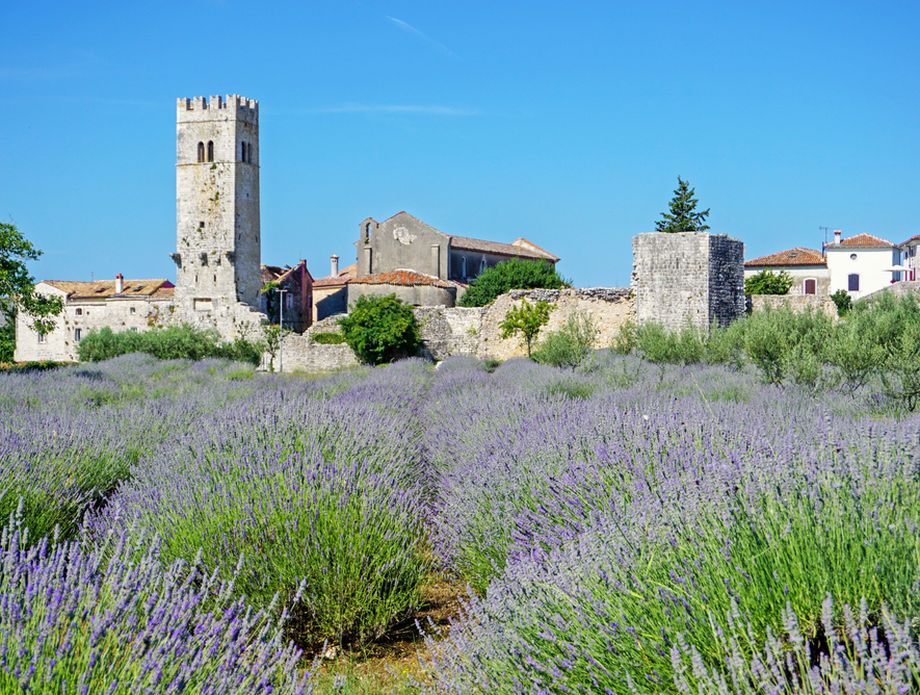
Dvigrad is a medieval town in Istria, Croatia, now abandoned. Inhabited from antiquity until the 17th century, it was deserted due to plague and wars. The ruins, including churches and city walls, offer insight into medieval life and architecture. It is a significant historical site and tourist attraction.
Dvigrad is a medieval town in Istria, Croatia, now abandoned. Inhabited from antiquity until the 17th century, it was deserted due to plague and wars. The ruins, including churches and city walls, offer insight into medieval life and architecture. It is a significant historical site and tourist attraction.
Rovinj, Church of St. Euphemia
Rovinj, Church of st.
Euphemia
Rovinj, Church of St. Euphemia
A Baroque-style church built in 1736. It's dedicated to Saint Euphemia, whose relics are housed there. The church features a bell tower modeled after St. Mark's in Venice, offering panoramic views of Rovinj and the Adriatic Sea.
The church holds a beautiful and fully restored 1754 organ by Antonio Barbini.
A Baroque-style church built in 1736. It's dedicated to Saint Euphemia, whose relics are housed there. The church features a bell tower modeled after St. Mark's in Venice, offering panoramic views of Rovinj and the Adriatic Sea.

Sv. Lovreč,
Basilica of St. Martin
Sv. Lovreč,
Basilica of St. Martin
A historic church dating back to the early medieval period. It features Romanesque architecture with later Gothic elements. The church is known for its well-preserved frescoes and its significance in the local cultural and religious history.
A historic church dating back to the early medieval period. It features Romanesque architecture with later Gothic elements. The church is known for its well-preserved frescoes and its significance in the local cultural and religious history.
Directions to Sv. Martin
Rovinj Church of St. Francis
Rovinj Church of St. Francis
The Church of St. Francis in Rovinj is a historic Baroque church built in the early 18th century as part of a Franciscan monastery complex. Known for its simple yet elegant architecture, the church houses valuable religious artworks and serves as an important cultural and spiritual landmark. Its peaceful atmosphere and historical significance make it a notable attraction for visitors exploring Rovinj’s rich heritage.
The Church of St. Francis in Rovinj is a historic Baroque church built in the early 18th century as part of a Franciscan monastery complex. Known for its simple yet elegant architecture, the church houses valuable religious artworks and serves as an important cultural and spiritual landmark. Its peaceful atmosphere and historical significance make it a notable attraction for visitors exploring Rovinj’s rich heritage.
Directions to St. Francis
